

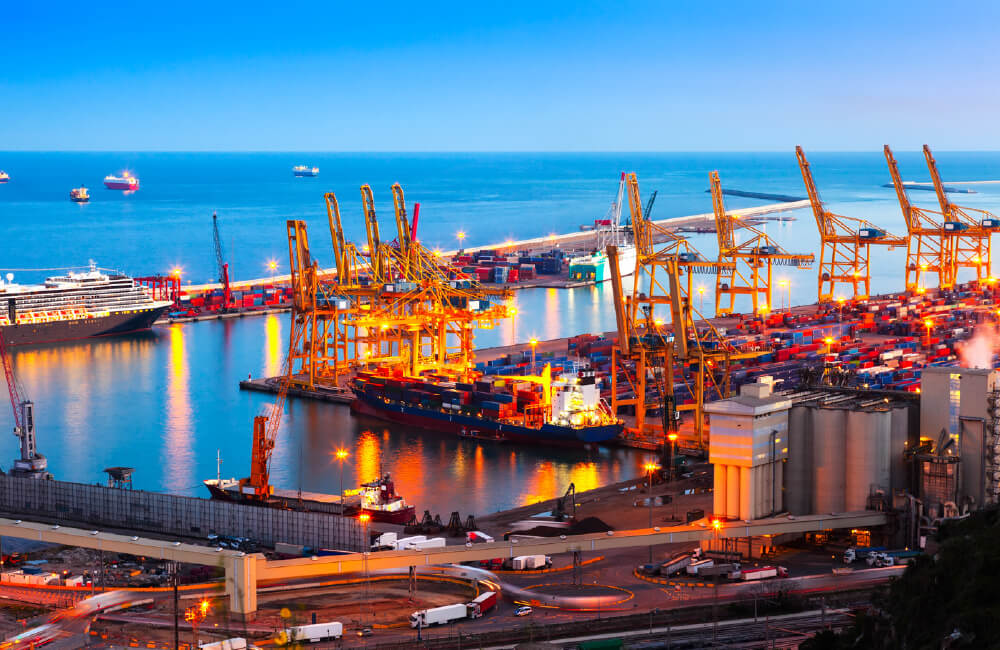
According to the plan, Ba Ria-Vung Tau has a bridge system deep sea port nearly 20km long, classified as special national, is the gateway to the East Sea of the Southeast and the Southern region.
With this advantage, Ba Ria-Vung Tau province has been implementing industry structure associated with the advantages of seaports.
Strength of port industry
Seaports and port services have developed strongly in recent years, gradually becoming an important economic pillar of Ba Ria-Vung Tau. From a few specialized ports serving the oil and gas industry and fishing, there are currently 57 planned ports in the province; of which 50 ports have been put into operation with a total design capacity of about 152 million tons/year.
At Cai Mep-Thi Vai port cluster, there are currently 24 projects in operation and the only wharf area for container handling with 8 container port projects coming into operation, with a designed capacity of 8.4 million TEUs/year. . This is the only port cluster in Vietnam and one of 19 ports in the world that can receive container ships with a tonnage of over 200,000DWT; The design capacity as planned can be through about 220 million tons/year.
The efficiency of seagoing cargo exploitation will increase from 40% in 2015 to 50% in 2021; the number of container ships going directly to North America and Europe from 9 trips/week in 2015 increased to 24 trips/week in 2020.
According to Mr. John Campbell, Deputy Director, Head of Industrial Services Division of Savills Vietnam, Ba Ria-Vung Tau is an area that not only has competitive rents and infrastructure suitable for mid-range industry. heavy duty but also has access to a growing cluster of seaports.
Cụm cảng quốc tế Cái Mép-Thị Vải là giải pháp thay thế tuyệt vời cho hệ thống cảng đông đúc của Thành phố Hồ Chí Minh. Với chiều dài 20km và đã đón hơn 2 triệu TEU vào năm 2020, cảng Cái Mép đang nhận sự hỗ trợ lớn từ Chính phủ và sẽ trở thành trung tâm vận tải biển quan trọng vào năm 2045.
[Connecting seaports for industrial development: There is still a lot of room]
Along with seaport development, after 15 years of implementing Resolution 53-NQ/TW of the Politburo on socio-economic development and ensuring national defense and security in the Southeast region and the Southern key economic region. From the South to 2010, with orientation to 2020, Ba Ria-Vung Tau is evaluated as one of the localities with a modern and spacious transport infrastructure system. The province's road transport infrastructure system by 2020 has basically completed the common structural framework with 4,624km; of which 2,662km of road is asphalted.
According to Mr. Tran Thuong Chi, Director of the Department of Transport of Ba Ria-Vung Tau province, provincial roads combined with national highways form a network of horizontal and vertical roads that are interwoven and spread evenly, creating favorable conditions for development. industrial, tourist, urban and rural areas. The inland waterway port system is also invested and developed continuously with 71 inland waterway ports, which have contributed to meeting the demand for inland waterway transport and transshipment of goods supporting the Cai Mep-Thi Vai port system. .
Currently, domestic cargo accounts for more than 90% of the total volume of cargo through the southern port cluster, mainly from Ho Chi Minh City, Binh Duong, Dong Nai, Ba Ria-Vung Tau and the Delta region. Kowloon. The domestic market is expected to continue to be the main development driver for the operation of the Southern port cluster in general and Cai Mep-Thi Vai in particular in the coming period.
Up to now, Ba Ria-Vung Tau is the only locality in the country that has been conducting digital transformation in the management of seaport infrastructure with 10 digitized ports. The port system and port logistics services have become an important economic sector of the province, contributing increasingly to GRDP growth, local budget revenue and supporting industries, trade and services. develop.
Connecting to the port system
Over the years, many important traffic routes connecting the Cai Mep-Thi Vai port system with National Highway 51 have been invested in synchronously connecting the coastal economic corridor. Convenient transportation connections give Ba Ria-Vung Tau an advantage in attracting goods to Cai Mep-Thi Vai, serving up import and export activities between the province's seaport system and Ho Chi Minh City area. Minh, Mekong Delta and Southeast Asia.
Along with that, the province has invested in, basically renovating to reach the technical level of inland waterway routes; forming a cluster of ports to serve the needs of cargo collection and release for major seaports in the region; continue to develop and modernize the international gateway port of Cai Mep-Thi Vai into a large international transshipment port of Asian and international stature.
In order to develop transport infrastructure, ports serving multi-modal, regional, regional and world connections, in the coming time, the province will mobilize all resources to create investment capital for transport infrastructure. connection and port infrastructure to create a breakthrough in seaports and port logistics services, said Mr. Tran Thuong Chi.
Ba Ria-Vung Tau province also promotes the investment progress of traffic projects connecting Cai Mep-Thi Vai port area such as road 991B, road behind My Xuan port, Long Son-Cai Mep road, DT992 road from high Bien Hoa-Vung Tau expressway to National Highway 51… to connect economic regions and improve the efficiency of Cai Mep-Thi Vai transshipment port operation.
For regional linkage, Ba Ria-Vung Tau organizes implementation and closely coordinates with localities to invest in Ho Chi Minh City Ring Road 4 to connect Cai Mep-Thi Vai port area with Long Thanh International Airport and industrial and urban areas of 5 localities: Ba Ria-Vung Tau, Dong Nai, Binh Duong, Ho Chi Minh City and Long An. The province also coordinated and promoted the Ministry of Transport to study and deploy the Bien Hoa-Vung Tau railway line; in which priority is given to the section to Cai Mep port to develop multimodal transport.
From now to 2030, Ba Ria-Vung Tau will also mobilize all domestic and foreign resources to invest in synchronously and effectively put into operation projects such as the Cai Mep-Thi Vai seaport system in proportion to national special port, gateway port function, international transshipment; Large Logistics Center of the region and the world; establish a free trade zone in Cai Mep area.
Recently, Resolution 24-NQ/TW of the Politburo on socio-economic development and assurance of national defense and security in the Southeast region up to 2030, with a vision to 2045 has proposed solutions as the first. invest in completing the system of coastal roads through Ba Ria-Vung Tau province, Ho Chi Minh City.
At the same time, speed up and complete the urban railway in Ho Chi Minh City, the urban railway connecting Ho Chi Minh City with Binh Duong and Dong Nai provinces, the Thu Thiem-Long Thanh railway; study and invest in the Bien Hoa-Vung Tau freight railway connecting with Cai Mep-Thi Vai seaport.
Chairman of the People's Committee of Ba Ria-Vung Tau province Nguyen Van Tho said that the province continues to coordinate with ministries, sectors and localities in the region to speed up the implementation of technical infrastructure projects.
In particular, focusing on the transport infrastructure project connecting the region, connecting Cai Mep Ha free trade area with the seaport system, Long Thanh international airport, and the international financial center of Ho Chi Minh City. Minh, industrial parks, economic zones and urban centers develop in the Southeast region and the whole country, in the Trans-Asian economic corridor.
To create a new development step, Ba Ria-Vung Tau has been actively rebuilding the seaport system to become a large transshipment port, worthy of Asia, forming a logistics center, and becoming a public belt. Karma; in which, speeding up key transport projects connecting the region in the new period is an urgent step.